IELTS Academic · Test 11

IELTS Reading Practice Test 11

IELTS Reading Practice Test 11 is the Reading section of IELTS Mock Test 11: 3 passages and 40 questions in 60 minutes. Read the passages and questions here, then take the test on the timed screen and get your band at once.

  • 60 minutes
  • 40 questions
  • Band at once
Reading · Test 1160 minutes · 40 questions · band at once
Start Reading Test 11

The test starts as soon as you click

Passage 1Questions 1–13

Lighter than air

The invention of the hot-air balloon, and how it works today

On 21 November 1783, a large crowd in Paris watched two men rise into the sky beneath an enormous decorated balloon. Jean-François Pilâtre de Rozier, a young teacher of science, and the Marquis d'Arlandes, an army officer, remained in the air for about 25 minutes. They reached a height of roughly 900 metres and travelled some nine kilometres across the city before landing safely. It was the first time that human beings had been carried aloft in a free-flying craft, and the balloon that made it possible had been designed not by scientists but by two brothers who ran a paper business.

Joseph-Michel and Jacques-Étienne Montgolfier came from a family of paper manufacturers in the town of Annonay, in southern France. According to one story, Joseph became interested in the idea after noticing that clothes drying above a fire were lifted by the rising air, and the brothers began experimenting with bags of paper and fabric held over flames. Like most people of their time, however, they misunderstood what they had discovered. Believing that the smoke itself contained a special lifting gas, they deliberately burned materials that produced thick smoke, such as damp straw and wool. In reality, their balloons rose because the air inside was heated, and hot air is less dense than the cooler air surrounding it.

Their first public demonstration took place in Annonay on 4 June 1783. An unmanned balloon made of fabric lined with paper rose to an estimated height of between 1,600 and 2,000 metres and stayed aloft for about ten minutes. News of the event spread rapidly. In September, the brothers were invited to repeat it at the palace of Versailles, in front of King Louis XVI. Since nobody knew whether a living creature could survive at such heights, the passengers on this occasion were a sheep, a duck and a rooster. The flight lasted around eight minutes, and all three animals landed unharmed, which encouraged plans for a flight with human passengers. Before attempting a free flight, the Montgolfiers carried out a series of tests in which the balloon was tethered to the ground by ropes.

Just ten days after the flight over Paris, on 1 December 1783, the scientist Jacques Charles took off in a quite different kind of balloon, filled with hydrogen, a gas lighter than air that could be produced by pouring acid onto iron. Hydrogen balloons did not need to be heated and could therefore remain aloft for much longer. For most of the following century, they were the preferred choice of scientists and adventurers alike. Hot-air balloons, which required a constant fire, were difficult and dangerous to manage, and they almost disappeared.

Their revival came in 1960, when the American engineer Ed Yost made the first free flight in a modern hot-air balloon, near the town of Bruning in the state of Nebraska. Yost replaced the open fire with a burner fuelled by propane, a gas stored as a liquid under pressure, and made the envelope, the fabric bag that holds the hot air, from nylon. His design, refined by later manufacturers, remains the basis of almost every balloon flying today.

A modern hot-air balloon consists of three main parts. The envelope is made of long panels of coated nylon, sewn between strong vertical straps called load tapes, which carry the weight of the basket. At the base of the envelope is the skirt, made of a fire-resistant material to protect the fabric from the flame. Directly beneath it, the burner is mounted on a metal frame above the basket, and the propane is carried in cylinders inside the basket itself. Baskets are still usually made of wicker, a material that has been used since the earliest balloons because it is light, strong and flexible enough to absorb the shock of a heavy landing. To climb, the pilot operates the burner, heating the air inside the envelope; to descend, the pilot pulls a cord that opens a large circular flap at the top of the envelope, known as the parachute valve, allowing some of the hot air to escape.

What the pilot cannot do is steer. A balloon simply travels with the wind, and the only way to change direction is to rise or descend to a height at which the wind is blowing in a different direction. Experienced pilots therefore study weather forecasts with great care before every flight, and most flights take place shortly after sunrise or in the early evening, when winds are usually light and steady. Because the landing place cannot be known in advance, a vehicle usually follows the balloon by road to collect the passengers and equipment.
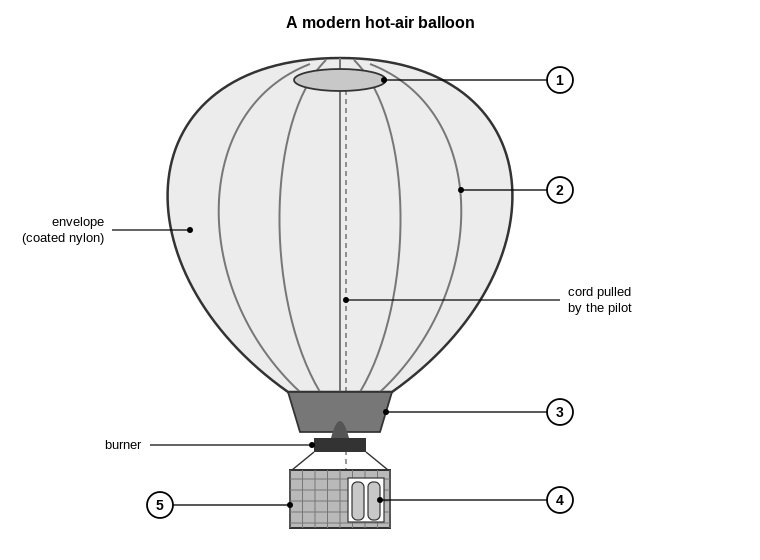
Questions 1–13

Questions 1–5Diagram label completion

Label the diagram below.

Write ONE WORD ONLY from the text for each answer.

A modern hot-air balloon with numbered labels: 1 the round flap at the top of the envelope, 2 one of the vertical straps on the envelope, 3 the band of fabric at the base of the envelope, 4 the fuel cylinders inside the basket, 5 the basket. The envelope, the burner and the cord pulled by the pilot are also labelled.

A modern hot-air balloon

Label 1: the 1 valve, which lets hot air escape

Label 2: load 2, which hold up the basket

Label 3: the 3, made of fire-resistant material

Label 4: cylinders containing 4

Label 5: a basket made of 5

Questions 6–13True/False/Not Given

Do the following statements agree with the information given in the text?

Choose TRUE if the statement agrees with the information given in the text, choose FALSE if the statement contradicts the information, or choose NOT GIVEN if there is no information on this.

  1. 6The Montgolfier brothers understood correctly why their balloons rose.
  2. 7The balloon flown at Annonay in June 1783 was made entirely of paper.
  3. 8Louis XVI asked to travel in one of the Montgolfiers' balloons.
  4. 9The animals carried at Versailles were not harmed by the flight.
  5. 10The Montgolfiers tested their balloon while it was attached to the ground before the first free flight with people.
  6. 11The balloon flown by Jacques Charles reached a greater height than the Montgolfier balloon over Paris.
  7. 12In the nineteenth century, hydrogen balloons were more widely used than hot-air balloons.
  8. 13Most balloon flights take place in the middle of the day.

Check your answers: take this test on the timed screen. Your band shows at once.

Start Reading Test 11
Passage 2Questions 14–26

Farming without fields

Can crops grown indoors, in stacked layers, help to feed the world's cities?

AIn a converted warehouse on the edge of a city, rows of lettuces grow in trays stacked ten layers high beneath the pink glow of artificial lights. There is no soil and no sunlight. The plants' roots hang in water or are sprayed with a fine mist containing every nutrient they need, while the temperature, humidity and even the carbon dioxide content of the air are controlled by computer. Supporters of this kind of agriculture, known as vertical farming, claim that it could transform the way in which cities are fed. Critics regard it as an extremely expensive way of growing salad.

BThe term itself is older than the technology. It was first used in 1915 by the American geologist Gilbert Ellis Bailey, in a book of the same name, although he was writing about something quite different: ways of reaching the deeper layers of soil, which included the use of explosives. The modern idea is usually traced to Dickson Despommier, a professor at Columbia University in New York. In 1999, he challenged his students to work out how much food could be grown on the rooftops of Manhattan. When they calculated that rooftop gardens could feed only a small fraction of the population, Despommier suggested growing crops inside multistorey buildings instead, and his later book helped to turn the concept into a business.

CThe advantages claimed for vertical farms are considerable. Because crops are grown indoors, they are protected from droughts, floods and pests, so harvests are reliable throughout the year and chemical pesticides are rarely needed. Water is recycled through the system, and some companies say that they use up to 95 per cent less than conventional farms. Since the farms can be built close to where people live, produce can reach shops within hours of being picked, reducing both transport and waste. And because the plants are stacked in layers, a single building can produce far more food from each square metre of land than a field. Some producers also argue that their crops taste better, because they are harvested when fully ripe rather than picked early to survive long journeys, although such claims are difficult to verify.

DThe main reason vertical farming became practical in the twenty-first century was the falling cost of LED lighting. Earlier artificial lights produced a great deal of heat and wasted much of their energy, but LEDs are far more efficient and can be designed to emit mainly the red and blue light that plants use most in photosynthesis, which is why many indoor farms are bathed in a pinkish glow. Even so, replacing the Sun is expensive. Electricity for lighting and for controlling the temperature is typically the largest single cost of running a vertical farm, and in regions where electricity is generated by burning fossil fuels, the environmental benefits of such farms may be smaller than they first appear.

EThe cost of lighting also explains why vertical farms grow such a narrow range of crops. Leafy vegetables and herbs such as lettuce, spinach and basil grow quickly, are almost entirely edible and sell at high prices, so the expense of lighting them can be recovered. Staple crops are another matter. In 2020, a team of researchers calculated that wheat grown in a ten-layer indoor facility could produce between 220 and 600 times as much grain from each hectare of land as the world's average field. The grain would be so expensive to produce, however, that it could not compete with wheat grown outdoors unless energy became far cheaper.

FThe industry's finances have also proved fragile. During the 2010s, investors poured money into vertical farming companies, some of which built enormous facilities. When energy prices rose sharply in 2022 and interest rates increased, several of the best-known firms ran into difficulty. AeroFarms, an American company that had been among the most prominent in the sector, filed for bankruptcy protection in June 2023, and others closed altogether or withdrew from some of the countries in which they operated. A number of analysts concluded that the industry had expanded too quickly, building very large farms before the economics had been proven, and that optimistic forecasts had rarely accounted for the full cost of buildings, equipment and specialist staff.

GFew experts now believe that vertical farms will replace conventional agriculture, but many see a role for them. In places with little farmland or a harsh climate, such as Singapore and the countries of the Persian Gulf, growing vegetables indoors can reduce dependence on imports. Singapore, which imports the great majority of its food, has actively encouraged indoor farming as part of a wider effort to produce more of what it eats. Some farms are being combined with renewable energy, or built beside power stations and factories so that they can make use of heat that would otherwise be wasted. The most likely future, in other words, is not a city fed entirely from towers, but one in which vertical farms supply a modest share of the fresh food that is most difficult to transport.

Questions 14–26

Questions 14–18Matching information

The text has seven paragraphs, A–G.

Which paragraph contains the following information?

Choose the correct letter, A–G. You may choose any letter more than once.

  1. 14the original meaning of a term
  2. 15a list of conditions that are managed inside an indoor farm
  3. 16an explanation of the unusual colour of the light in many indoor farms
  4. 17a calculation showing that one way of producing food would be inadequate
  5. 18a reference to using heat that would otherwise be lost
    Questions 19–20Multiple choice, two answers

    Choose TWO correct answers.

    Which TWO advantages of vertical farms are mentioned in the text?

    • A They need fewer workers than ordinary farms.
    • B Their harvests are not affected by bad weather.
    • C They can grow any type of crop.
    • D Their produce can reach shops very soon after harvesting.
    • E They do not need any electricity.
    Questions 21–22Multiple choice, two answers

    Choose TWO correct answers.

    Which TWO causes of the financial problems of vertical farming companies are mentioned?

    • A a rise in energy prices
    • B a fall in demand for fresh vegetables
    • C higher interest rates
    • D new government regulations
    • E competition from imported food
    Questions 23–26Summary completion

    Complete the summary using the list of words, A–H, below.

    Choose the correct answer and move it into the gap.

    Which crops suit vertical farms?

    Vertical farms mainly grow leafy vegetables and herbs, which grow 23, can be eaten almost completely and fetch high prices. A study of wheat found that a ten-layer facility could produce hundreds of times more grain per 24 than an average field. However, the grain would be too 25 to compete with wheat grown 26.

    • A quickly
    • B hectare
    • C expensive
    • D outdoors
    • E slowly
    • F building
    • G cheap
    • H abroad

    Check your answers: take this test on the timed screen. Your band shows at once.

    Start Reading Test 11
    Passage 3Questions 27–40

    When money backfires

    Paying people to do the right thing can sometimes make them less likely to do it

    Economists have traditionally taken a simple view of human behaviour: if you want people to do more of something, pay them, and if you want them to do less of it, make it more expensive. This principle explains a great deal, from the way shoppers respond to discounts to the way employees respond to bonuses. Over the past few decades, however, a series of studies has revealed situations in which offering money produces the opposite of the intended result. Understanding when and why this happens matters, because governments, schools and employers increasingly rely on financial rewards and penalties to influence behaviour.

    The best-known example comes from a group of day-care centres in Haifa, Israel. Parents who arrived late to collect their children obliged teachers to stay after closing time, so the economists Uri Gneezy and Aldo Rustichini arranged for some of the centres to introduce a small fine for parents who were more than ten minutes late. The result surprised almost everyone: the number of late arrivals rose significantly. Before the fine, parents had presumably felt some guilt about inconveniencing the teachers; once a price had been attached to lateness, many seem to have regarded extra childcare as a service they could simply pay for. Most remarkably, when the fine was withdrawn some weeks later, lateness remained at its new, higher level. Once a moral obligation has been turned into a transaction, it seems, it can be difficult to turn it back.

    Psychologists and economists describe this phenomenon as crowding out: an external reward displaces the internal motives, such as duty, generosity or pride, that previously drove a particular behaviour. The idea was anticipated as early as 1970 by the British social scientist Richard Titmuss, who argued that paying blood donors would reduce both the quantity and the quality of the blood supplied. His claim was controversial at the time, but a Swedish experiment published in 2008 offered some support for it. When women who had expressed interest in giving blood were offered a small payment, the proportion who actually donated fell from 52 per cent to 30 per cent. Yet when they were given the option of passing the payment to a children's charity, donations returned to their original level, suggesting that it was personal financial gain, rather than money as such, that discouraged them. Men, interestingly, were unaffected.

    Similar effects have been observed in very different settings. In the 1990s, residents of Swiss communities that were being considered as sites for a nuclear waste store were asked whether they would accept it, and around half said that they would. When the same question was asked with an offer of generous financial compensation, support fell to about a quarter, apparently because people who had been prepared to accept a burden out of civic duty felt that they were being bribed. Even young children appear to be affected. In a classic study published in 1973, nursery school children who enjoyed drawing were promised a certificate for producing pictures. Later, once the rewards had ended, these children chose to spend less of their free time drawing than children who had received no reward, as if an activity they had once enjoyed for its own sake had become a kind of work.

    None of this means that financial incentives never work. They are often highly effective when a task is dull and offers little satisfaction in itself, or when the people involved are poor enough for a modest payment to make a real difference to their lives. Mexico's Progresa programme, launched in 1997, made regular payments to mothers in poor families on condition that their children attended school and that family members visited health clinics, and careful evaluations found that school enrolment rose. Its success led to similar programmes in many other countries, although later studies suggest that their effects depend heavily on local circumstances, including the quality of the schools and clinics that families are being encouraged to use. The lesson of this research, then, is not that money corrupts every good intention, but that it interacts with motives that economists long ignored.

    In my view, three principles follow. First, before introducing a reward or a penalty, policymakers should ask what already motivates the people concerned; where behaviour rests on duty or generosity, money may do more harm than good. Second, small payments are often the worst of both worlds, since they can destroy an existing sense of obligation without being large enough to provide a strong financial motive. Gneezy and Rustichini demonstrated this in a separate experiment, in which students collecting donations for charity raised less money when they were offered a small commission than when they were offered nothing at all. Third, rewards that recognise people, such as public thanks or the opportunity to help others, tend to reinforce rather than replace their own motives, as the Swedish women who could pass their payment to charity illustrate.

    Economists were right to insist that incentives matter, but wrong to assume that money is the only incentive that does. People are moved by what others think of them, by what they think of themselves and by their sense of what is fair, and a payment can alter all three. The challenge for anyone designing a system of rewards is to work with these motives rather than against them.

    Questions 27–40

    Questions 27–31Yes/No/Not Given

    Do the following statements agree with the claims of the writer in the text?

    Choose YES if the statement agrees with the claims of the writer, choose NO if the statement contradicts the claims of the writer, or choose NOT GIVEN if it is impossible to say what the writer thinks about this.

    1. 27The traditional economic view of behaviour is useful in many situations.
    2. 28Removing the fine in Haifa brought lateness back to its earlier level.
    3. 29Titmuss's argument about paid blood donation was widely accepted when he made it.
    4. 30The Swiss residents would have accepted the nuclear waste store if the compensation had been higher.
    5. 31A small payment can be less effective than offering no payment at all.
    Questions 32–35Multiple choice

    Choose the correct answer.

    1. 32

      What did the Swedish experiment show about the women who were interested in giving blood?

      • A Most of them refused to donate under any conditions.
      • B Fewer of them donated when they were offered money for themselves.
      • C They donated more often when the payment was increased.
      • D They preferred to keep the payment rather than give it to charity.
    2. 33

      What point does the study of nursery school children illustrate?

      • A Rewards can reduce interest in an activity that people already enjoy.
      • B Children need more encouragement to draw.
      • C Rewards affect children and adults in different ways.
      • D Certificates work better than money as rewards.
    3. 34

      According to the text, when are financial incentives most likely to succeed?

      • A when people already have a strong sense of duty
      • B when the reward is announced in public
      • C when the payment offered is very small
      • D when a task is boring or the payment matters greatly to the people receiving it
    4. 35

      What did families have to do to receive payments from Progresa?

      • A find regular paid work
      • B move closer to a town
      • C send their children to school
      • D attend training courses for parents
    Questions 36–40Summary completion

    Complete the summary below.

    Write NO MORE THAN TWO WORDS from the text for each answer.

    Designing rewards

    When an external reward replaces the motives that used to drive a behaviour, the effect is known as 36. The writer advises policymakers to consider what already 37 people before introducing rewards or penalties, because where behaviour depends on duty or 38, money may do more harm than good. Rewards that recognise people, such as public 39, tend to strengthen their own motives. People are influenced by the opinions of others, by their view of themselves and by their sense of what is 40.

    Check your answers: take this test on the timed screen. Your band shows at once.

    Start Reading Test 11

    More IELTS reading practice tests

    See all 11 IELTS reading practice tests

    One-to-one trial lesson · $10

    I'll help you prepare for the IELTS test

    After the IELTS free mock tests, book a trial lesson with me to talk about your goals. In the lesson I read your writing and listen to you speak. Together we set the band your university or employer asks for, and then I make you a preparation plan up to test day.

    • Direct feedback on your Writing and Speaking
    • Practice on the hardest parts of the test
    • A preparation plan up to your test date
    25 minutes · Live and one-to-one · Book at a time that suits you
    Teacher Abdulrahman, a certified English teacher at C2 level, who reviews your IELTS mock tests in the trial lesson
    Book a trial lesson with me to talk about your goalsTeacher AbdulrahmanCertified English teacher · C2 level
    5.0★★★★★Student rating
    C2English level
    B.EdBachelor in English teaching
    TEFLCertified teaching qualification
    DiplomaThe Academic British Institute
    10+years teaching
    300+lessons with students

    A certified English teacher at C2 level, with a Bachelor of Education in English teaching, the TEFL professional certificate and a diploma in English from The Academic British Institute, and more than ten years of teaching. Helps you get ready for IELTS: reads your writing, listens to your speaking and makes you a plan up to test day.

    IELTS free mock tests from Live English, not affiliated with IELTS or any organisation that runs the test. Bands are estimates. Official test information: ielts.org.