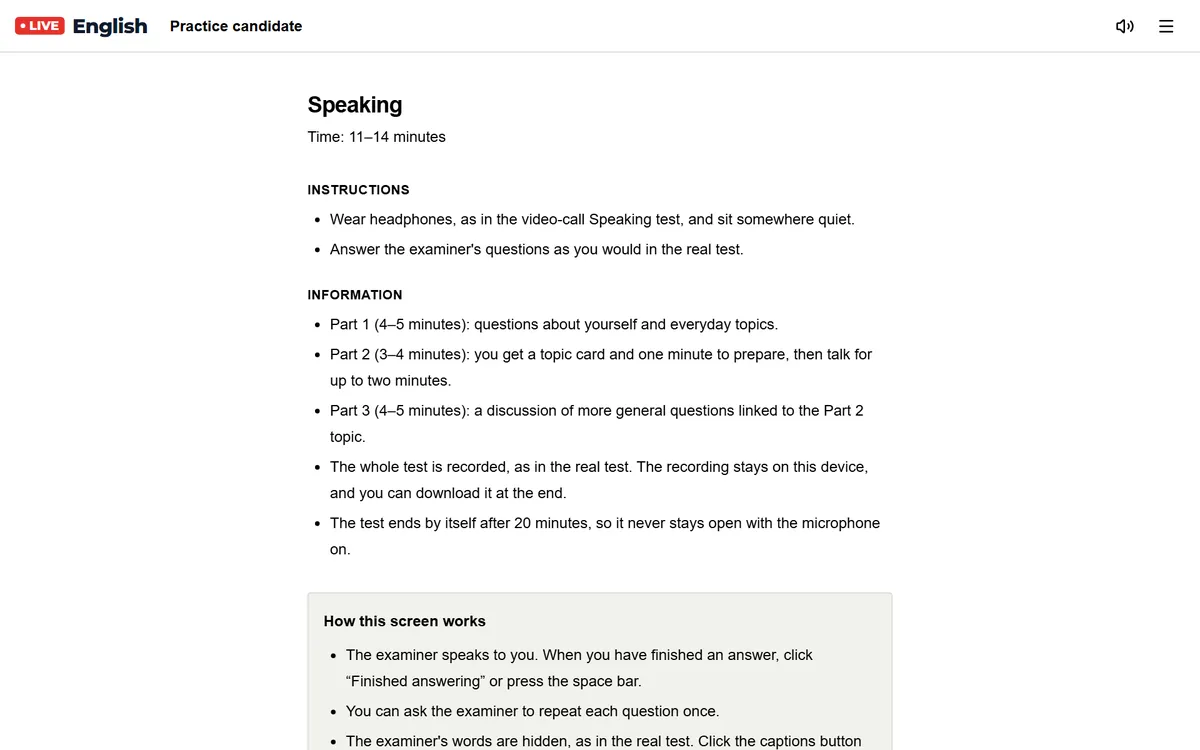
The examiner checks who you are, then asks general questions on familiar topics such as home, family, work, studies or interests.
Free IELTS speaking practice
IELTS Speaking Test Practice
Practise for the IELTS speaking test with a full interview: Part 1, Part 2 and Part 3 in 11 to 14 minutes, with an examiner on the screen. Choose from 11 tests, and the teacher assesses your speaking in a trial lesson.
- Parts 1, 2 and 3
- A microphone check first
- No sign-up
Click Start: a short microphone check comes first, then the interview.
IELTS Speaking11 practice tests
Start Speaking Test 1
Or choose another test
- 11–14 min
- 3 parts
- Teacher feedback
Choose your IELTS speaking test
An examiner on the screen Your answers are recorded The questions of every test on its own page
Test 111–14 min · 3 parts
- 1Part 1: Housework, names and smiling
- 2Part 2: Describe a person from history that you would like to meet
- 3Part 3: Learning about history; heroes
Test 211–14 min · 3 parts
- 1Part 1: Where you live, the weather and photographs
- 2Part 2: Describe a time when you helped someone
- 3Part 3: Helping people in the community; jobs that involve helping people
Test 311–14 min · 3 parts
- 1Part 1: Your daily routine, music and parks
- 2Part 2: Describe a skill that you learned as an adult
- 3Part 3: Learning new skills; skills and work
Test 411–14 min · 3 parts
- 1Part 1: Weekends, cooking and birthdays
- 2Part 2: Describe a quiet place where you like to spend time
- 3Part 3: Relaxing in modern life; technology and free time
Test 511–14 min · 3 parts
- 1Part 1: Your hometown, reading and sleep
- 2Part 2: Describe an older person you know and admire
- 3Part 3: Older people in society; different generations
Test 611–14 min · 3 parts
- 1Part 1: Getting around, colours and sport
- 2Part 2: Describe something you bought that you were very pleased with
- 3Part 3: Shopping habits; repairing and replacing things
Test 711–14 min · 3 parts
- 1Part 1: Your home, friends and handwriting
- 2Part 2: Describe a live performance that you enjoyed watching
- 3Part 3: Live entertainment; performing in public
Test 811–14 min · 3 parts
- 1Part 1: Being on time, plants and the night sky
- 2Part 2: Describe a building that you think is attractive
- 3Part 3: Old buildings; buildings in cities
Test 911–14 min · 3 parts
- 1Part 1: Animals, breakfast and humour
- 2Part 2: Describe a difficult decision that you had to make
- 3Part 3: Making decisions; getting advice
Test 1011–14 min · 3 parts
- 1Part 1: Maps, coffee and tea and keys
- 2Part 2: Describe something that you made by hand
- 3Part 3: Handmade things; creativity
Test 1111–14 min · 3 parts
- 1Part 1: Public holidays, working in teams and the sea
- 2Part 2: Describe an occasion when someone surprised you
- 3Part 3: Planning and surprises; coping with change
How the IELTS Speaking test works
The IELTS Speaking test is a face-to-face interview with an examiner, and it is recorded. It takes 11 to 14 minutes and has three parts. The Speaking test is the same for IELTS Academic and General Training.
You get a task card with a topic and the points to cover. You have one minute to prepare and make notes, then you talk for 2 minutes. The examiner may ask one or two questions after.
You and the examiner discuss more general and abstract ideas linked to the Part 2 topic.
- 11 to 14 minutes for the 3 parts
- Recorded: the real test is recorded too
- Four criteria: fluency, vocabulary, grammar, pronunciation
- One minute to prepare in Part 2
How examiners mark your Speaking
Fluency and coherence
How well you keep talking at a normal speed, with your ideas in a logical order.
Lexical resource
The range of words you use, and how well you explain yourself when you don't know a word.
Grammatical range and accuracy
The range of your grammar, and how accurately you use it.
Pronunciation
How easily you can be understood.
You need a microphone. Wear headphones and sit somewhere quiet, as you would for the real test.
IELTS speaking test tips
- 1Answer, then add one detail
In Part 1, give a full answer and one reason or example. Don't stop at yes or no.
- 2Use the minute
In Part 2, write a few key words for each point on the card, not full sentences.
- 3Keep going for two minutes
In Part 2, keep talking until the examiner stops you: add an example or a story.
- 4Give reasons in Part 3
Explain why, compare and give examples. The questions are more general here.
One-to-one trial lesson · $10
I'll help you prepare for the IELTS test
After the IELTS free mock tests, book a trial lesson with me to talk about your goals. In the lesson I read your writing and listen to you speak. Together we set the band your university or employer asks for, and then I make you a preparation plan up to test day.
- Direct feedback on your Writing and Speaking
- Practice on the hardest parts of the test
- A preparation plan up to your test date

Book a trial lesson with me to talk about your goalsTeacher AbdulrahmanCertified English teacher · C2 level
5.0★★★★★Student rating
C2English level
B.EdBachelor in English teaching
TEFLCertified teaching qualification
DiplomaThe Academic British Institute
10+years teaching
300+lessons with students
A certified English teacher at C2 level, with a Bachelor of Education in English teaching, the TEFL professional certificate and a diploma in English from The Academic British Institute, and more than ten years of teaching. Helps you get ready for IELTS: reads your writing, listens to your speaking and makes you a plan up to test day.
IELTS speaking test practice: your questions
Is this IELTS speaking test practice free?
Yes. All 11 Speaking tests are free, and you don't need an account. You need a microphone.
How long is the IELTS Speaking test?
11 to 14 minutes, in three parts.
Who marks my speaking?
The screen does not mark it. You can send your recording to the teacher, who listens to it before your trial lesson and assesses your level.
Is IELTS Speaking the same for Academic and General Training?
Yes. The Speaking test is the same in both.
Can I see the questions before I start?
Yes. Each test has its own page with all its questions, so you can look at them first.
Are these tests from IELTS?
No. These practice tests come from Live English. They are not affiliated with IELTS or any organisation that runs the test.
IELTS free mock tests from Live English, not affiliated with IELTS or any organisation that runs the test. Bands are estimates. Official test information: ielts.org.